transformed data {
  real mu;
  real<lower=0> tau;
  real alpha;
  int N;
  mu = 8;
  tau = 3;
  alpha = 10;
  N = 800;
}
generated quantities {
  real mu_print;
  real tau_print;
  vector[N] theta;
  vector[N] sigma;
  vector[N] y;
  mu_print = mu;
  tau_print = tau;
  for (i in 1:N) {
    theta[i] = normal_rng(mu, tau);
    sigma[i] = alpha;
    y[i] = normal_rng(theta[i], sigma[i]);
  }
}Pathologies in hierarchical models
FW 891
Click here to view presentation online
Christopher Cahill
16 October 2023
Purpose
- Introduce some background and theoretical concepts
- The Devil’s funnel (spooky seaz’n 👻)
- What to do about it
- Example
- Example #2 (Eight schools)
Background
- Many of the most exciting problems in applied statistical ecology involve intricate, high-dimensional models, and sparse data (at least relative to model complexity)
Betancourt and Girolami 2013
Background
Many of the most exciting problems in applied statistical ecology involve intricate, high-dimensional models, and sparse data (at least relative to model complexity)
In situations where the data alone cannot identify a model, significant prior information is required to draw valid inference
Betancourt and Girolami 2013
Background
Many of the most exciting problems in applied statistical ecology involve intricate, high-dimensional models, and sparse data (at least relative to model complexity)
In situations where the data alone cannot identify a model, significant prior information is required to draw valid inference
Such prior information is not limited to an explicit prior distribution, but instead can be encoded in the model construction itself 🤯
Betancourt and Girolami 2013
A one level hierarchical model
\[ \pi(\theta, \phi \mid \mathcal{D}) \propto \prod_{i=1}^{n} \pi\left(\mathcal{D}_{i} \mid \theta_{i}\right) \pi\left(\theta_{i} \mid \phi\right) \pi(\phi) \]
Betancourt and Girolami 2013
A one level hierarchical model
\[ \pi(\theta, \phi \mid \mathcal{D}) \propto \prod_{i=1}^{n} \pi\left(\mathcal{D}_{i} \mid \theta_{i}\right) \pi\left(\theta_{i} \mid \phi\right) \pi(\phi) \]
- Hierarchical models are defined by the organization of a model’s parameters into exchangeable groups, and the resulting conditional independencies between those groups
Betancourt and Girolami 2013
A one level hierarchical model
\[ \pi(\theta, \phi \mid \mathcal{D}) \propto \prod_{i=1}^{n} \pi\left(\mathcal{D}_{i} \mid \theta_{i}\right) \pi\left(\theta_{i} \mid \phi\right) \pi(\phi) \]
Hierarchical models are defined by the organization of a model’s parameters into exchangeable groups, and the resulting conditional independencies between those groups
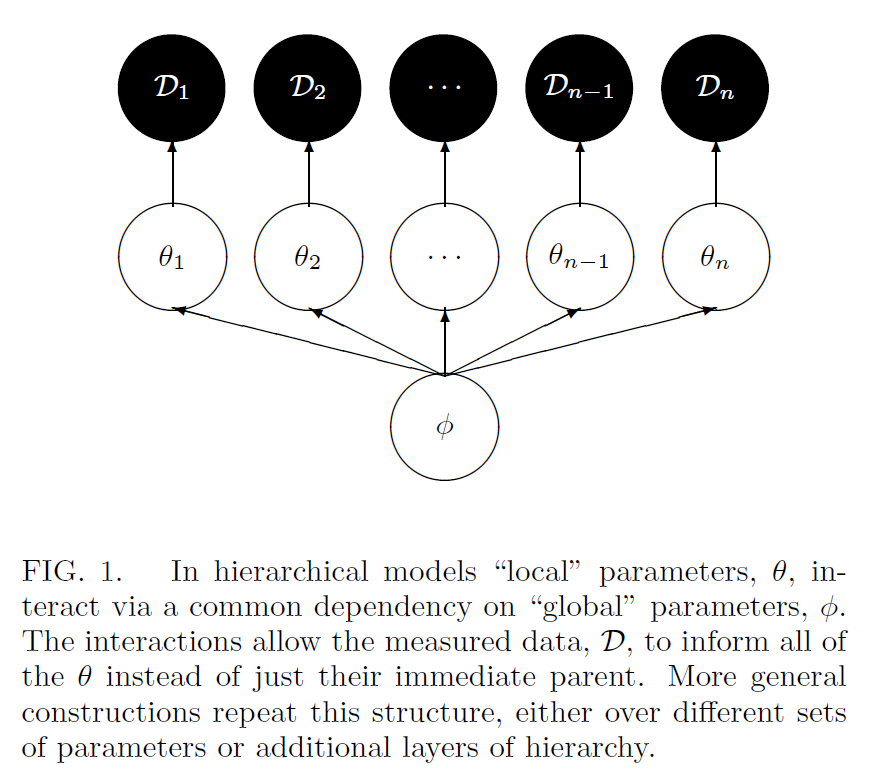
Can also visualize this as a directed acyclic graph (DAG)
Betancourt and Girolami 2013
Hierarchical DAG
Betancourt and Girolami 2013
A one-level hierarchical model
\[ \begin{aligned} y_{i} & \sim {N}\left(\theta_{i}, \sigma_{i}^{2}\right) \\ \theta_{i} & \sim {N}\left(\mu, \tau^{2}\right), \text { for } i=1, \ldots, I \end{aligned} \]
Betancourt and Girolami 2013
A one-level hierarchical model
\[ \begin{aligned} y_{i} & \sim {N}\left(\theta_{i}, \sigma_{i}^{2}\right) \\ \theta_{i} & \sim {N}\left(\mu, \tau^{2}\right), \text { for } i=1, \ldots, I \end{aligned} \]
- In terms of the previous equations, \(\mathcal{D}=\left(y_{i}, \sigma_{i}\right), \phi=(\mu, \tau), \text { and } \theta=\left(\theta_{i}\right)\)
Betancourt and Girolami 2013
A one-level hierarchical model
\[ \begin{aligned} y_{i} & \sim {N}\left(\theta_{i}, \sigma_{i}^{2}\right) \\ \theta_{i} & \sim {N}\left(\mu, \tau^{2}\right), \text { for } i=1, \ldots, I \end{aligned} \]
- In terms of the previous equations, \(\mathcal{D}=\left(y_{i}, \sigma_{i}\right), \phi=(\mu, \tau), \text { and } \theta=\left(\theta_{i}\right)\)
- Call any elements of \(\phi\) global parameters
Betancourt and Girolami 2013
A one-level hierarchical model
\[ \begin{aligned} y_{i} & \sim {N}\left(\theta_{i}, \sigma_{i}^{2}\right) \\ \theta_{i} & \sim {N}\left(\mu, \tau^{2}\right), \text { for } i=1, \ldots, I \end{aligned} \]
- In terms of the previous equations, \(\mathcal{D}=\left(y_{i}, \sigma_{i}\right), \phi=(\mu, \tau), \text { and } \theta=\left(\theta_{i}\right)\)
- Call any elements of \(\phi\) global parameters
- Call any elements of \(\theta\) local parameters
Betancourt and Girolami 2013
A one-level hierarchical model
\[ \begin{aligned} y_{i} & \sim {N}\left(\theta_{i}, \sigma_{i}^{2}\right) \\ \theta_{i} & \sim {N}\left(\mu, \tau^{2}\right), \text { for } i=1, \ldots, I \end{aligned} \]
- In terms of the previous equations, \(\mathcal{D}=\left(y_{i}, \sigma_{i}\right), \phi=(\mu, \tau), \text { and } \theta=\left(\theta_{i}\right)\)
- Call any elements of \(\phi\) global parameters
- Call any elements of \(\theta\) local parameters
- However, recognize this nomencalture breaks down in situations with more levels
Betancourt and Girolami 2013
A key pathology
- Unfortunately, this one-level model exhibits some of the typical pathologies of hierarchical models
- Small changes in \(\phi\) induce large changes in density
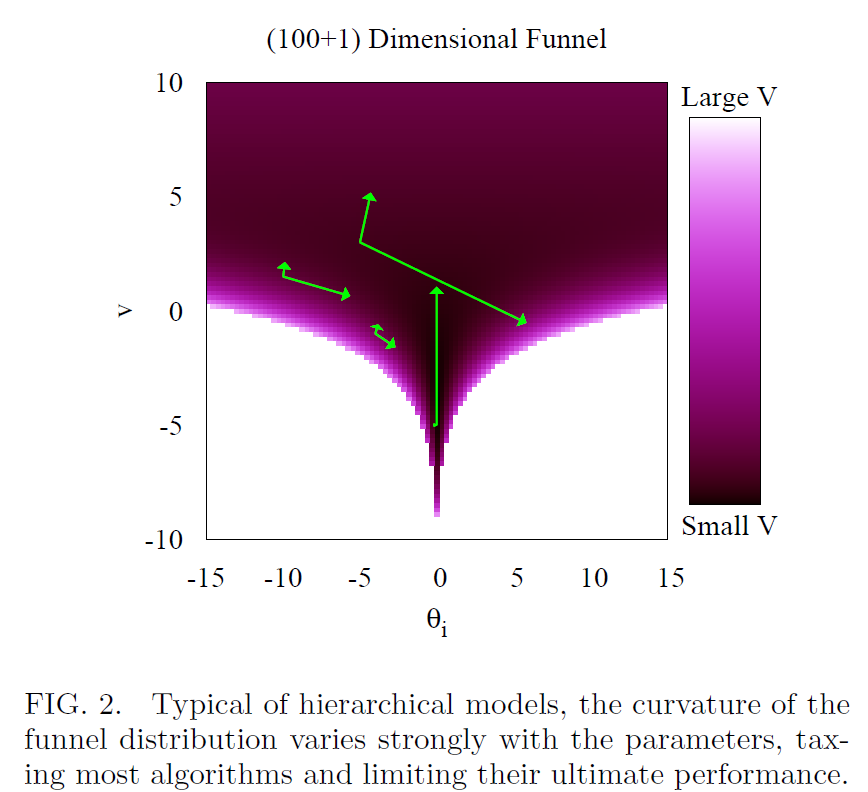
- When data are sparse, the density of these models looks like a “funnel”
- Region of high density but low volume, and a region of low density but high volume
- However, the probability mass of these two regions is the same (or nearly so)
- Any algorithm must be able to manage the dramatic variations in curvature to fully map out the posterior
Betancourt and Girolami 2013
Naive model implementations
- Assuming a normal model with no data, a latent mean \(\mu\) set at zero, and a lognormal prior on the variance \(\tau^{2}=e^{v^{2}}\)
Betancourt and Girolami 2013
Naive model implementations
- Assuming a normal model with no data, a latent mean \(\mu\) set at zero, and a lognormal prior on the variance \(\tau^{2}=e^{v^{2}}\)
\[ \pi\left(\theta_{1}, \ldots, \theta_{n}, v\right) \propto \prod_{i=1}^{n} N\left(x_{i} \mid 0,\left(e^{-v / 2}\right)^{2}\right) N\left(v \mid 0,3^{2}\right) \]
Betancourt and Girolami 2013
Naive model implementations
- Assuming a normal model with no data, a latent mean \(\mu\) set at zero, and a lognormal prior on the variance \(\tau^{2}=e^{v^{2}}\)
\[ \pi\left(\theta_{1}, \ldots, \theta_{n}, v\right) \propto \prod_{i=1}^{n} N\left(x_{i} \mid 0,\left(e^{-v / 2}\right)^{2}\right) N\left(v \mid 0,3^{2}\right) \]
- This hierarchical structure induces large correlations between \(v\) and each \(\theta_{i}\)
Betancourt and Girolami 2013
Visualizing the pathology 😈
Some things worth noting
- There is position dependence in the correlation structure, i.e., correlation changes depending on where you are located in the posterior
Betancourt and Girolami 2013
Some things worth noting
- There is position dependence in the correlation structure, i.e., correlation changes depending on where you are located in the posterior
- No global correction, like rotating or rescaling will solve this problem!
Betancourt and Girolami 2013
Some things worth noting
- There is position dependence in the correlation structure, i.e., correlation changes depending on where you are located in the posterior
- No global correction, like rotating or rescaling will solve this problem!
- Often manifests as a divergent transition in Stan, as HMC cannot accurately explore the posterior
Betancourt and Girolami 2013
How can we fix this problem?
- Remember that the prior information we include in an analysis is not only limited to the choice of an explict prior distribution
Betancourt and Girolami 2013
How can we fix this problem?
- Remember that the prior information we include in an analysis is not only limited to the choice of an explict prior distribution
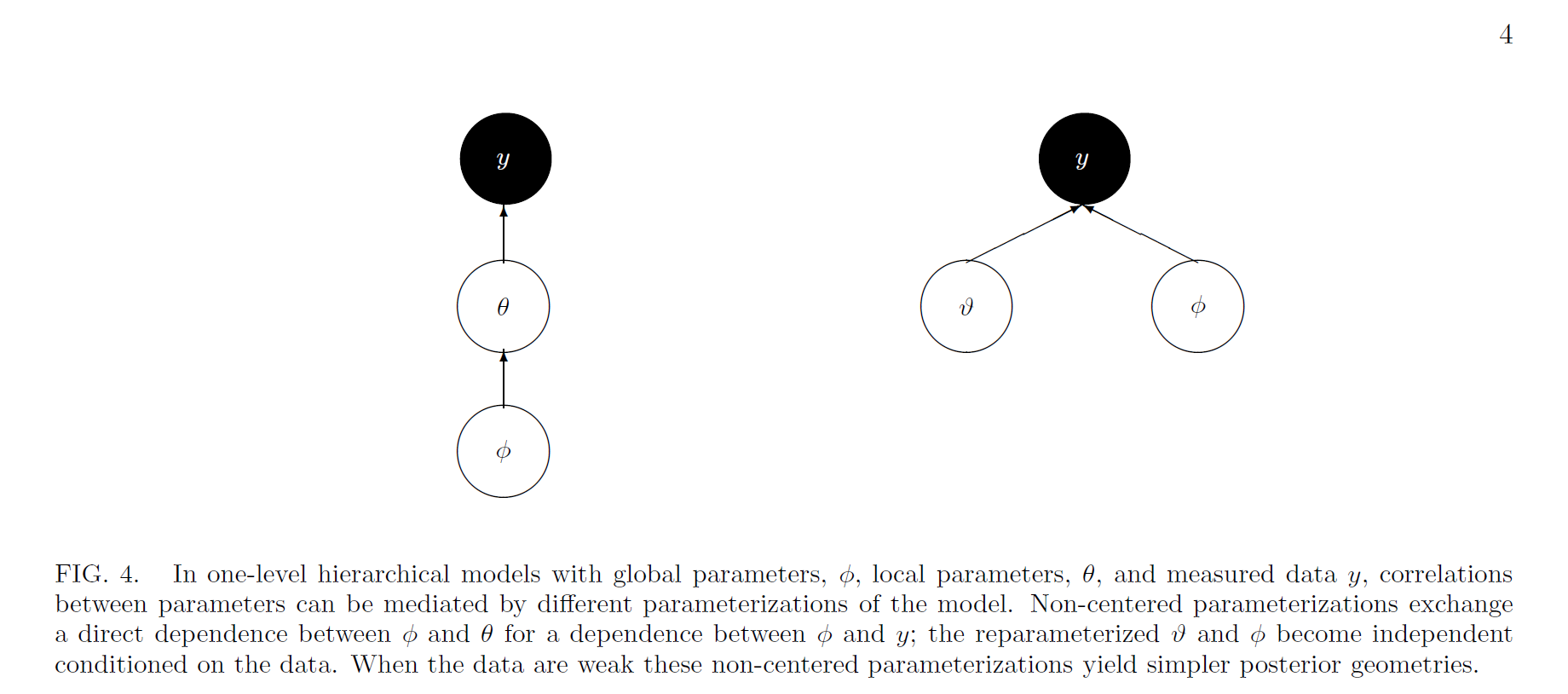
- The dependence between layers in our model can actually be broken up by reparameterizing the existing parameters into a so-called “non-centered” parameterization
- Think about the DAG Betancourt and Girolami 2013
How can we fix this problem?
- Remember that the prior information we include in an analysis is not only limited to the choice of an explict prior distribution
- The dependence between layers in our model can actually be broken up by reparameterizing the existing parameters into a so-called “non-centered” parameterization
- Think about the DAG
- Non-centered parameterizations factor certain dependencies into deterministic transformations between the layers, leaving the actively sampled variables uncorrelated
Betancourt and Girolami 2013
Centered vs. non-centered model maths
Centered model: \[ \begin{aligned} y_{i} & \sim {N}\left(\theta_{i}, \sigma_{i}^{2}\right) \\ \theta_{i} & \sim {N}\left(\mu, \tau^{2}\right), \end{aligned} \]
Non-centered analog:
Betancourt and Girolami 2013
Centered vs. non-centered model maths
Centered model: \[ \begin{aligned} y_{i} & \sim {N}\left(\theta_{i}, \sigma_{i}^{2}\right) \\ \theta_{i} & \sim {N}\left(\mu, \tau^{2}\right), \end{aligned} \]
Non-centered analog:
\[ \begin{aligned} y_{i} & \sim N\left(\vartheta_{i} \tau+\mu, \sigma_{i}^{2}\right) \\ \vartheta_{i} & \sim N(0,1). \end{aligned} \]
Betancourt and Girolami 2013
Centered vs. non-centered model maths
Centered model: \[ \begin{aligned} y_{i} & \sim {N}\left(\theta_{i}, \sigma_{i}^{2}\right) \\ \theta_{i} & \sim {N}\left(\mu, \tau^{2}\right), \end{aligned} \]
Non-centered analog:
\[ \begin{aligned} y_{i} & \sim N\left(\vartheta_{i} \tau+\mu, \sigma_{i}^{2}\right) \\ \vartheta_{i} & \sim N(0,1). \end{aligned} \]
Key point: NCP shifts correlation from the latent parameters to data
Betancourt and Girolami 2013
Centered vs. non-centered model DAG
Betancourt and Girolami 2013
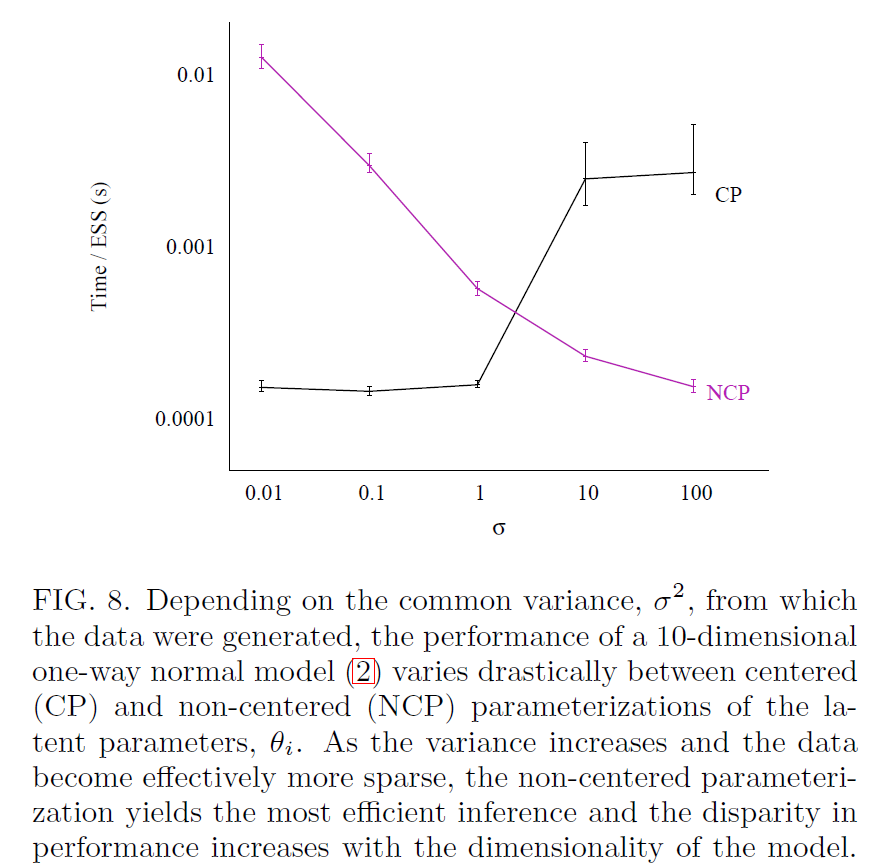
When does NCP help?
Betancourt and Girolami 2013
Example

Example
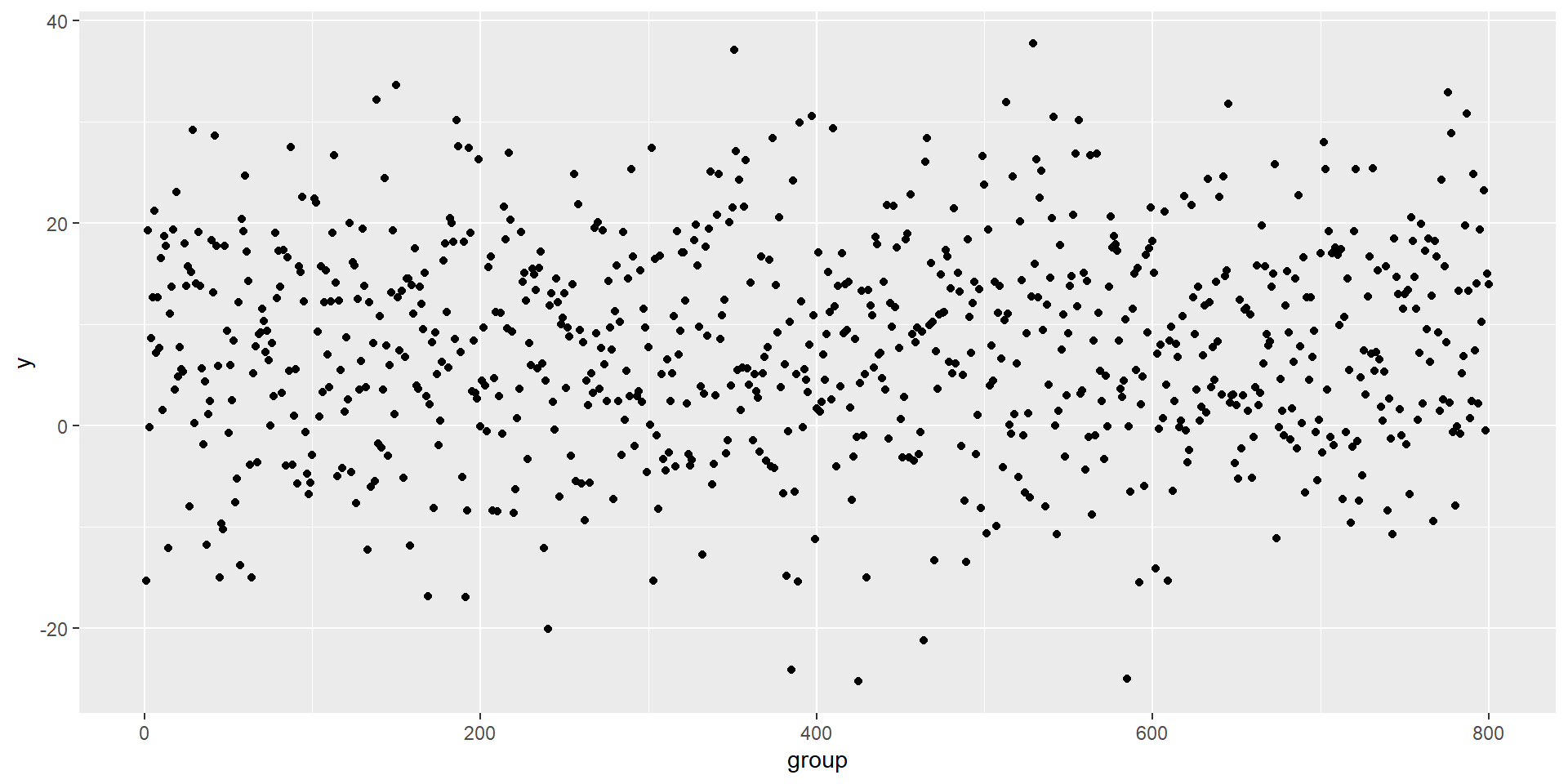
- consider the one-way normal model with 800 latent \(\theta_{i}\)
- constant measurement error \(\sigma_{i} = \sigma = 10\)
- latent parameters are \(\mu = 8, \tau = 3\)
- \(\theta_{i}\) and \(y_{i}\) sampled randomly
Betancourt and Girolami 2013
Example
- consider the one-way normal model with 800 latent \(\theta_{i}\)
- constant measurement error \(\sigma_{i} = \sigma = 10\)
- latent parameters are \(\mu = 8, \tau = 3\)
- \(\theta_{i}\) and \(y_{i}\) sampled randomly
Add weakly informative priors to this generative likelihood
\[ \begin{array}{l} \pi(\mu)=N\left(0,5^{2}\right) \\ \pi(\tau)=\text { Half-Cauchy }(0,2.5) . \end{array} \]
Betancourt and Girolami 2013
Example, centered vs. noncentered
The centered parameterization of this model can be written as
\[ \begin{aligned} y_{i} & \sim N\left(\theta_{i}, \sigma_{i}^{2}\right) \\ \theta_{i} & \sim N\left(\mu, \tau^{2}\right), \text { for } i=1, \ldots, 800 \end{aligned} \]
Betancourt and Girolami 2013
Example, centered vs. noncentered
The centered parameterization of this model can be written as
\[ \begin{aligned} y_{i} & \sim N\left(\theta_{i}, \sigma_{i}^{2}\right) \\ \theta_{i} & \sim N\left(\mu, \tau^{2}\right), \text { for } i=1, \ldots, 800 \end{aligned} \]
and it should have inferior performance relative to the noncentered model:
\[ \begin{aligned} y_{i} & \sim N\left(\tau \vartheta_{i}+\mu, \sigma_{i}^{2}\right) \\ \vartheta_{i} & \sim N(0,1), \text { for } i=1, \ldots, 800 \end{aligned} \]
Betancourt and Girolami 2013
Using Stan to simulate fake data
Calling that from R
library("cmdstanr")

one_level <- cmdstan_model("src/sim_one_level.stan")

# simulate data
sim <- one_level$sample(
  fixed_param = T, # look here
  iter_warmup = 0, iter_sampling = 1,
  chains = 1, seed = 1
)
Running MCMC with 1 chain...
Chain 1 Iteration: 1 / 1 [100%] (Sampling)
Chain 1 finished in 0.0 seconds.- Note the fixed_param and iters
Extract the relevant quantities
# extract it
y <- as.vector(sim$draws("y", format = "draws_matrix"))
sigma <- as.vector(sim$draws("sigma", format = "draws_matrix"))
theta <- as.vector(sim$draws("theta", format = "draws_matrix"))
mu <- as.vector(sim$draws("mu_print", format = "draws_matrix"))
tau <- as.vector(sim$draws("tau_print", format = "draws_matrix"))
Look at it (duh)
The centered parameterization in code
The noncentered parameterization in code
data {
  int<lower=0> J;
  array[J] real y;
  array[J] real sigma;
}
parameters {
  real mu;
  real<lower=0> tau;
  array[J] real var_theta;
}
transformed parameters {
  array[J] real theta;
  for (j in 1:J) theta[j] = tau * var_theta[j] + mu;
}
model {
  mu ~ normal(0, 5);
  tau ~ cauchy(0, 2.5);
  var_theta ~ normal(0, 1);
  y ~ normal(theta, sigma);
}
Running things from R
# Centered estimation model:
stan_data <- list(
  J = length(y), y = y, sigma = sigma
)
one_level_cp <- cmdstan_model("src/one_level_cp.stan")

fit_cp <- one_level_cp$sample(
  data = stan_data,
  iter_warmup = 1000, iter_sampling = 1000,
  chains = 4, parallel_chains = 4,
  seed = 13, refresh = 0, adapt_delta = 0.99
)
Running MCMC with 4 parallel chains...
Chain 1 finished in 7.4 seconds.
Chain 4 finished in 8.2 seconds.
Chain 3 finished in 9.5 seconds.
Chain 2 finished in 13.8 seconds.
All 4 chains finished successfully.
Mean chain execution time: 9.7 seconds.
Total execution time: 14.0 seconds.Checking diagnostics
Processing csv files: C:/Users/Chris/AppData/Local/Temp/RtmpmEiqtE/one_level_cp-202310152224-1-6bae41.csv, C:/Users/Chris/AppData/Local/Temp/RtmpmEiqtE/one_level_cp-202310152224-2-6bae41.csv, C:/Users/Chris/AppData/Local/Temp/RtmpmEiqtE/one_level_cp-202310152224-3-6bae41.csv, C:/Users/Chris/AppData/Local/Temp/RtmpmEiqtE/one_level_cp-202310152224-4-6bae41.csv

Checking sampler transitions treedepth.
Treedepth satisfactory for all transitions.

Checking sampler transitions for divergences.
No divergent transitions found.

Checking E-BFMI - sampler transitions HMC potential energy.
The E-BFMI, 0.00, is below the nominal threshold of 0.30 which suggests that HMC may have trouble exploring the target distribution.
If possible, try to reparameterize the model.

The following parameters had fewer than 0.001 effective draws per transition:
  tau
Such low values indicate that the effective sample size estimators may be biased high and actual performance may be substantially lower than quoted.

The following parameters had split R-hat greater than 1.05:
  mu, tau, theta[29], theta[42], theta[87], theta[113], theta[138], theta[143], theta[150], theta[186], theta[187], theta[193], theta[199], theta[217], theta[240], theta[256], theta[290], theta[302], theta[337], theta[342], theta[351], theta[352], theta[358], theta[374], theta[385], theta[386], theta[390], theta[397], theta[410], theta[425], theta[464], theta[465], theta[466], theta[499], theta[500], theta[513], theta[517], theta[529], theta[531], theta[533], theta[534], theta[541], theta[554], theta[556], theta[563], theta[567], theta[585], theta[633], theta[642], theta[645], theta[673], theta[687], theta[702], theta[721], theta[731], theta[776], theta[778], theta[787], theta[791]
Such high values indicate incomplete mixing and biased estimation.
You should consider regularizating your model with additional prior information or a more effective parameterization.

Processing complete.
Running things from R
# noncentered estimation model:
one_level_ncp <- cmdstan_model("src/one_level_ncp.stan")

fit_ncp <- one_level_ncp$sample(
  data = stan_data,
  iter_warmup = 1000, iter_sampling = 1000,
  chains = 4, parallel_chains = 4,
  seed = 13, refresh = 0, adapt_delta = 0.99
)
Running MCMC with 4 parallel chains...
Chain 2 finished in 9.9 seconds.
Chain 4 finished in 10.4 seconds.
Chain 1 finished in 10.7 seconds.
Chain 3 finished in 15.9 seconds.
All 4 chains finished successfully.
Mean chain execution time: 11.7 seconds.
Total execution time: 16.0 seconds.Checking diagnostics
Processing csv files: C:/Users/Chris/AppData/Local/Temp/RtmpmEiqtE/one_level_ncp-202310152224-1-0e1b62.csv, C:/Users/Chris/AppData/Local/Temp/RtmpmEiqtE/one_level_ncp-202310152224-2-0e1b62.csv, C:/Users/Chris/AppData/Local/Temp/RtmpmEiqtE/one_level_ncp-202310152224-3-0e1b62.csv, C:/Users/Chris/AppData/Local/Temp/RtmpmEiqtE/one_level_ncp-202310152224-4-0e1b62.csv

Checking sampler transitions treedepth.
Treedepth satisfactory for all transitions.

Checking sampler transitions for divergences.
No divergent transitions found.

Checking E-BFMI - sampler transitions HMC potential energy.
E-BFMI satisfactory.

Effective sample size satisfactory.

Split R-hat values satisfactory all parameters.

Processing complete, no problems detected.
Comparing the two models
# A tibble: 2 × 10
  variable  mean median    sd   mad    q5   q95  rhat ess_bulk ess_tail
  <chr>    <num>  <num> <num> <num> <num> <num> <num>    <num>    <num>
1 mu        7.79   7.76 0.373 0.413 7.25   8.45  1.19    15.0     152.
2 tau 1.82 1.94 1.09 1.31 0.251 3.45 2.02 5.50 12.2# A tibble: 2 × 10
variable mean median sd mad q5 q95 rhat ess_bulk ess_tail
<chr> <num> <num> <num> <num> <num> <num> <num> <num> <num>
1 mu 7.88 7.87 0.355 0.340 7.28 8.47 1.00 6132. 2937.
2 tau 1.68 1.65 0.994 1.16 0.177 3.34 1.01 479. 1147.First example wrap up
- The centered parameterization throws low-EBFMI warnings, occasional divergent transition warnings, and maximum treedepth reached warnings
- NCP increases efficiency (measured as ESS / run time)
Eight schools in class demo
Centered model: \[ \begin{aligned} y_{j} & \sim \operatorname{Normal}\left(\theta_{j}, \sigma_{j}\right), \quad j=1, \ldots, J \\ \theta_{j} & \sim \operatorname{Normal}(\mu, \tau), \quad j=1, \ldots, J \\ \mu & \sim \operatorname{Normal}(0,10) \\ \tau & \sim \operatorname{half}-\operatorname{Cauchy}(0,10) \end{aligned} \]
Non-centered analog:
\[ \begin{aligned}\theta _j&=\ \mu +\tau \eta _j,\quad j=1,\ldots ,J\\ \eta _j&\sim N(0,1),\quad j=1,\ldots ,J.\end{aligned} \]
Rubin 1981, Gelman et al. 2013; Stan Development Team 2023
Key thing to note about Eight Schools NCP vs. CP
- NCP replaces the vector \(\theta\) with a vector \(\eta\) of i.i.d. standard normal parameters and then constructs \(\theta\) deterministically from \(\eta\) by scaling by \(\tau\) and shifting by \(\mu\)
Rubin 1981, Gelman et al. 2013; Stan Development Team 2023
Key thing to note about Eight Schools NCP vs. CP
NCP replaces the vector \(\theta\) with a vector \(\eta\) of i.i.d. standard normal parameters and then constructs \(\theta\) deterministically from \(\eta\) by scaling by \(\tau\) and shifting by \(\mu\)
To the code!
Rubin 1981, Gelman et al. 2013; Stan Development Team 2023
References
Betancourt, M. and Girolami, M. 2013. Hamiltonian Monte Carlo for hierarchical models. https://arxiv.org/abs/1312.0906
Gelman, A., Carlin, J. B., Stern, H. S., Dunson, D. B., Vehtari, A., and Rubin, D. B. 2013. Bayesian Data Analysis. Chapman & Hall/CRC Press, London, third edition.
Rubin, D. B. 1981. Estimation in Parallel Randomized Experiments. Journal of Educational and Behavioral Statistics. 6:377–401.
Stan Development Team. 2023. Stan Modeling Language Users Guide and Reference Manual. https://mc-stan.org/users/documentation/