Model selection and cross validation
FW 891
Click here to view presentation online
8 November 2023
Purpose
- Goal
- A philosophical preface to model selection
- k-fold and loo cross validation
- Performance criteria
- Challenges
- Approximate methods to loo cross validation
- R and Stan demo on how to implement these ideas
Useful reference on cross validation in Stan:
TLDR: Model selection is hard and requires careful thought
Model selection: are we stuck between the devil and the deep blue sea?
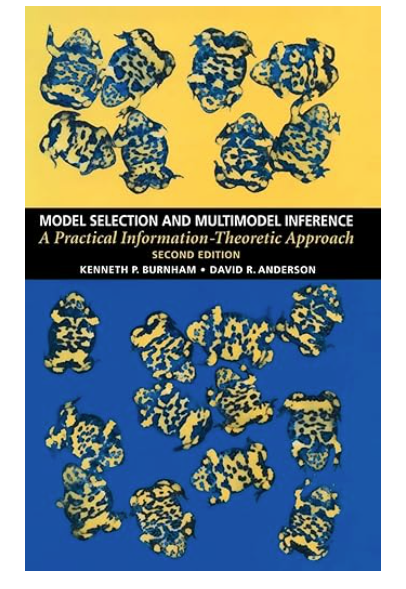

Burnham and Anderson 1998; Navarro 2018; Bolker 2023
Between the devil and the deep blue sea?
- We can calculate how well we predict things
Navarro 2018; Bolker 2023
Between the devil and the deep blue sea?
- We can calculate how well we predict things
- The difference between prediction and inference
Navarro 2018; Bolker 2023
Between the devil and the deep blue sea?
- We can calculate how well we predict things
- The difference between prediction and inference
- If scientific reasoning takes place in a world where all our models are systematically wrong in some sense, what do we hope to achieve by selecting a model?
Navarro 2018; Bolker 2023
Between the devil and the deep blue sea?
- We can calculate how well we predict things
- The difference between prediction and inference
- If scientific reasoning takes place in a world where all our models are systematically wrong in some sense, what do we hope to achieve by selecting a model?
- The devil: statistical decision making
Navarro 2018; Bolker 2023
Between the devil and the deep blue sea?
- We can calculate how well we predict things
- The difference between prediction and inference
- If scientific reasoning takes place in a world where all our models are systematically wrong in some sense, what do we hope to achieve by selecting a model?
- The devil: statistical decision making
- The deep blue sea: addressing scientific questions
Navarro 2018; Bolker 2023
Between the devil and the deep blue sea?
- We can calculate how well we predict things
- The difference between prediction and inference
- If scientific reasoning takes place in a world where all our models are systematically wrong in some sense, what do we hope to achieve by selecting a model?
- The devil: statistical decision making
- The deep blue sea: addressing scientific questions
- A question well worth pondering that I have no intention of answering:
Navarro 2018; Bolker 2023
Between the devil and the deep blue sea?
- We can calculate how well we predict things
- The difference between prediction and inference
- If scientific reasoning takes place in a world where all our models are systematically wrong in some sense, what do we hope to achieve by selecting a model?
- The devil: statistical decision making
- The deep blue sea: addressing scientific questions
- A question well worth pondering that I have no intention of answering:
- Are scientific model selection questions addressable with statistical tools?
Navarro 2018; Bolker 2023
With that in mind

Arthur Schopenhauer the philosophy Bunny peering into the inferential abyss
Introduction
- After fitting a Bayesian model, we often want to measure its predictive accuracy
Vehtari et al. 2019
Introduction
- After fitting a Bayesian model, we often want to measure its predictive accuracy
- We might do this to:
Vehtari et al. 2019
Introduction
- After fitting a Bayesian model, we often want to measure its predictive accuracy
- We might do this to:
- For its own sake
Vehtari et al. 2019
Introduction
- After fitting a Bayesian model, we often want to measure its predictive accuracy
- We might do this to:
- For its own sake
- Compare models
Vehtari et al. 2019
Introduction
- After fitting a Bayesian model, we often want to measure its predictive accuracy
- We might do this to:
- For its own sake
- Compare models
- Model selection
Vehtari et al. 2019
Introduction
- After fitting a Bayesian model, we often want to measure its predictive accuracy
- We might do this to:
- For its own sake
- Compare models
- Model selection
- Model averaging
Vehtari et al. 2019
What is cross validation?
- Cross validation is a family of techniques that try to estimate how well a model would predict previously unseen data
Vehtari 2023
What is cross validation?
- Cross validation is a family of techniques that try to estimate how well a model would predict previously unseen data
- Typically do this by fitting the model to some subset of the data, and then predicting the left out data
Vehtari 2023
What is cross validation?
- Cross validation is a family of techniques that try to estimate how well a model would predict previously unseen data
- Typically do this by fitting the model to some subset of the data, and then predicting the left out data
- Cross validation can be used to
Vehtari 2023
What is cross validation?
- Cross validation is a family of techniques that try to estimate how well a model would predict previously unseen data
- Typically do this by fitting the model to some subset of the data, and then predicting the left out data
- Cross validation can be used to
- Assess the predictive performance of a single model
Vehtari 2023
What is cross validation?
- Cross validation is a family of techniques that try to estimate how well a model would predict previously unseen data
- Typically do this by fitting the model to some subset of the data, and then predicting the left out data
- Cross validation can be used to
- Assess the predictive performance of a single model
- Assess model misspecification
Vehtari 2023
What is cross validation?
- Cross validation is a family of techniques that try to estimate how well a model would predict previously unseen data
- Typically do this by fitting the model to some subset of the data, and then predicting the left out data
- Cross validation can be used to
- Assess the predictive performance of a single model
- Assess model misspecification
- Compare multiple models
Vehtari 2023
What is cross validation?
- Cross validation is a family of techniques that try to estimate how well a model would predict previously unseen data
- Typically do this by fitting the model to some subset of the data, and then predicting the left out data
- Cross validation can be used to
- Assess the predictive performance of a single model
- Assess model misspecification
- Compare multiple models
- Select a single model from multiple candidates
Vehtari 2023
What is cross validation?
- Cross validation is a family of techniques that try to estimate how well a model would predict previously unseen data
- Typically do this by fitting the model to some subset of the data, and then predicting the left out data
- Cross validation can be used to
- Assess the predictive performance of a single model
- Assess model misspecification
- Compare multiple models
- Select a single model from multiple candidates
- Combine the predictions of multiple models
Vehtari 2023
K-fold and leave-one-out cross validation
- K-fold cross validation refers to splitting a dataset into K approximately equal sized chunks
K-fold and leave-one-out cross validation
- K-fold cross validation refers to splitting a dataset into K approximately equal sized chunks
- Often K = 10
K-fold and leave-one-out cross validation
- K-fold cross validation refers to splitting a dataset into K approximately equal sized chunks
- Often K = 10
- Procedure:
- Estimate the model on K-1 of the chunks then predict the left out chunk
K-fold and leave-one-out cross validation
- K-fold cross validation refers to splitting a dataset into K approximately equal sized chunks
- Often K = 10
- Procedure:
- Estimate the model on K-1 of the chunks then predict the left out chunk
- Repeat this process until we’ve shuffled through each chunk or fold of the data
K-fold and leave-one-out cross validation
- K-fold cross validation refers to splitting a dataset into K approximately equal sized chunks
- Often K = 10
- Procedure:
- Estimate the model on K-1 of the chunks then predict the left out chunk
- Repeat this process until we’ve shuffled through each chunk or fold of the data
- Leave one out (LOO) cross validation represents the limit of K-fold cross validation, where K equals number of data points
Some measures of predictive accuracy
Mean Square Error (MSE)
\[ \frac{1}{n} \sum_{i=1}^{n}\left(y_{i}-\mathrm{E}\left(y_{i} \mid \theta\right)\right)^{2} \]
- \(y_{i}\) is data point i
- \(\theta\) represent fitted model parameters
- proportional to MSE if model is normal with constant variance
- Easy to compute and understand, but less appropriate for non-normal models
Gelman et al. 2014; Vehtari et al. 2016
Expected log pointwise predictive density (elpd)
- Consider data \(y_{1}, ... , y_{n}\) modeled as independent given parameters \(\theta\)
- Also suppose we have a prior distribution \(p(\theta)\) yielding a posterior \(p(\theta \mid y)\)
- And a posterior predictive distribution \(p(\tilde{y} \mid y)=\int p\left(\tilde{y}_{i} \mid \theta\right) p(\theta \mid y) d \theta\)
Gelman et al. 2014; Vehtari et al. 2016
Expected log pointwise predictive density (elpd)
Consider data \(y_{1}, ... , y_{n}\) modeled as independent given parameters \(\theta\)
Also suppose we have a prior distribution \(p(\theta)\) yielding a posterior \(p(\theta \mid y)\)
And a posterior predictive distribution \(p(\tilde{y} \mid y)=\int p\left(\tilde{y}_{i} \mid \theta\right) p(\theta \mid y) d \theta\)
We can then define a measure of predictive accuracy for the n data points as:
Gelman et al. 2014; Vehtari et al. 2016
Expected log pointwise predictive density (elpd)
Consider data \(y_{1}, ... , y_{n}\) modeled as independent given parameters \(\theta\)
Also suppose we have a prior distribution \(p(\theta)\) yielding a posterior \(p(\theta \mid y)\)
And a posterior predictive distribution \(p(\tilde{y} \mid y)=\int p\left(\tilde{y}_{i} \mid \theta\right) p(\theta \mid y) d \theta\)
We can then define a measure of predictive accuracy for the n data points as:
\[ \begin{aligned} \text { elpd } & =\text { expected } \log \text { pointwise predictive density for a new dataset } \\ & =\sum_{i=1}^{n} \log \left(\frac{1}{S} \sum_{s=1}^{S} p\left(y_{i} \mid \theta^{s}\right)\right) . \end{aligned} \]
Gelman et al. 2014; Vehtari et al. 2016
Expected log pointwise predictive density (elpd)
Consider data \(y_{1}, ... , y_{n}\) modeled as independent given parameters \(\theta\)
Also suppose we have a prior distribution \(p(\theta)\) yielding a posterior \(p(\theta \mid y)\)
And a posterior predictive distribution \(p(\tilde{y} \mid y)=\int p\left(\tilde{y}_{i} \mid \theta\right) p(\theta \mid y) d \theta\)
We can then define a measure of predictive accuracy for the n data points as:
\[ \begin{aligned} \text { elpd } & =\text { expected } \log \text { pointwise predictive density for a new dataset } \\ & =\sum_{i=1}^{n} \log \left(\frac{1}{S} \sum_{s=1}^{S} p\left(y_{i} \mid \theta^{s}\right)\right) . \end{aligned} \]
- where \(\theta^{s}\) represent posterior simulations from \(s=1, \ldots, s\)
Gelman et al. 2014; Vehtari et al. 2016
Some extensions to simple k-fold cross validation
- Often the data are subsetted randomly; however, this may not always represent the relevant prediction task
Roberts et al. 2017
Some extensions to simple k-fold cross validation
- Often the data are subsetted randomly; however, this may not always represent the relevant prediction task
- Ecological data are commonly correlated in space, time, groups, or even phylogenetic structure
Roberts et al. 2017
Some extensions to simple k-fold cross validation
- Often the data are subsetted randomly; however, this may not always represent the relevant prediction task
- Ecological data are commonly correlated in space, time, groups, or even phylogenetic structure
- Dependency in groups, space, or time
Roberts et al. 2017
Some extensions to simple k-fold cross validation
- Often the data are subsetted randomly; however, this may not always represent the relevant prediction task
- Ecological data are commonly correlated in space, time, groups, or even phylogenetic structure
- Dependency in groups, space, or time
- Many strategies we can use depending on our prediction task
Roberts et al. 2017
Cross validation and LOO have many limitations
Some known issues
- Computationally demanding
Gelman et al. 2013; Vehtari 2023
Some known issues
- Computationally demanding
- Methods run into problems with sparse data
Gelman et al. 2013; Vehtari 2023
Some known issues
- Computationally demanding
- Methods run into problems with sparse data
- When to not use cross-validation?
- In general, there is no need to do any model selection
Gelman et al. 2013; Vehtari 2023
Some known issues
- Computationally demanding
- Methods run into problems with sparse data
- When to not use cross-validation?
- In general, there is no need to do any model selection
- Best approach is to build a rich model that includes all uncertainties, do model checking, and perhaps adjust that model if necessary
Gelman et al. 2013; Vehtari 2023
Some known issues
- Computationally demanding
- Methods run into problems with sparse data
- When to not use cross-validation?
- In general, there is no need to do any model selection
- Best approach is to build a rich model that includes all uncertainties, do model checking, and perhaps adjust that model if necessary
- Cross validation cannot directly answer the question “do the data provide evidence for some effect being non-zero?”
Gelman et al. 2013; Vehtari 2023
Some known issues
- Computationally demanding
- Methods run into problems with sparse data
- When to not use cross-validation?
- In general, there is no need to do any model selection
- Best approach is to build a rich model that includes all uncertainties, do model checking, and perhaps adjust that model if necessary
- Cross validation cannot directly answer the question “do the data provide evidence for some effect being non-zero?”
- What does cross validation tell you?
Gelman et al. 2013; Vehtari 2023
How do you view the world?
M-closed vs. M-open worlds

Navarro 2019
Approximate methods for calculating elpd (sneakery)
Approximate cross validation
- Vehtari et al. (2016; 2017) introduced a method that approximates the evaluations of leave-one-out cross validation inexpensively using only the data point log likelihoods of a single model fit
Vehtari et al. 2016; 2017
Approximate cross validation
Vehtari et al. (2016; 2017) introduced a method that approximates the evaluations of leave-one-out cross validation inexpensively using only the data point log likelihoods of a single model fit
Pareto-smoothed importance sampling (PSIS-LOO) allows us to compute an approximation to LOO without re-fitting the model many times
Vehtari et al. 2016; 2017
Importance sampling LOO
- Since we are Bayesian, we have samples from a posterior
- Approximate the likelihood our model would give some datum if we hadn’t observed that datum:
\[ \int p\left(y_{1} \mid \theta\right) d \theta \]
- Since we are working with samples we move from an integral to an average over samples:
\[ \frac{1}{S} \sum_{s} p\left(y_{1} \mid \theta_{s}\right) \]
Vehtari et al. 2016; 2017
Importance sampling LOO
- Now we want to reweight the posterior samples as thought \(y_{1}\) wasn’t observed:
\[ \frac{1}{\sum_{s} w_{s}} \sum_{s} w_{s} p\left(y_{1} \mid \theta_{s}\right) \]
- The weighting we will use:
\[ \frac{1}{p\left(y_{1} \mid \theta_{s}\right)} \]
Vehtari et al. 2016; 2017
The Pareto part
- It turns out that importance sampling is very noisy, and the sampling weights have very heavy tails
Vehtari et al. 2016; 2017
The Pareto part
- It turns out that importance sampling is very noisy, and the sampling weights have very heavy tails
- We need to smooth out the tails so that a single datum doesn’t dominate our adjusted posterior
Vehtari et al. 2016; 2017
The Pareto part
- It turns out that importance sampling is very noisy, and the sampling weights have very heavy tails
- We need to smooth out the tails so that a single datum doesn’t dominate our adjusted posterior
- Turns out the upper tail of the importance weights fits a generalized Pareto distribution nicely and we can use this to smooth out our weights \(w_{s}\)
Vehtari et al. 2016; 2017
PSIS-LOO implementation
- If all of that overwhelms you…
Vehtari et al. 2016; 2017
PSIS-LOO implementation
- If all of that overwhelms you…
- There are packages and functions that help you do this
Vehtari et al. 2016; 2017
PSIS-LOO implementation
- If all of that overwhelms you…
- There are packages and functions that help you do this
- They have a lot of diagnostics to tell you when they think they are going wrong
Vehtari et al. 2016; 2017
To the R and Stan code
References
Burnham and Anderson 1998. Model selection and inference: a practical information-theoretic approach. Springer-Verlag, New York, USA.
Gelman , A., Hwang, J. & Vehtari , A. 2014. Understanding predictive information criteria for Bayesian models. Stat. Comput., 24, 997 1016.
Navarro, D.J. 2019. Between the devil and the deep blue sea: tensions between scientific judgement and statistical model selection. Compuational Brain and Behavior. 2:28-34.
Vehtari, Aki, Andrew Gelman, and Jonah Gabry. 2017. “Practical Bayesian Model Evaluation Using Leave-One-Out Cross-Validation and WAIC.” Statistics and Computing 27 (5): 1413–32.
Vehtari, A., Simpson, D., Gelman, A., Yao, Y., and Gabry, J. 2019. Pareto smoothed importance sampling. preprint arXiv:1507.02646.
Vehtari 2023. https://users.aalto.fi/~ave/CV-FAQ.html#1_What_is_cross-validation